Why Settling for "Standard" Veneers is a Risk to Your Health
Why You Should Never Sacrifice Your Enamel
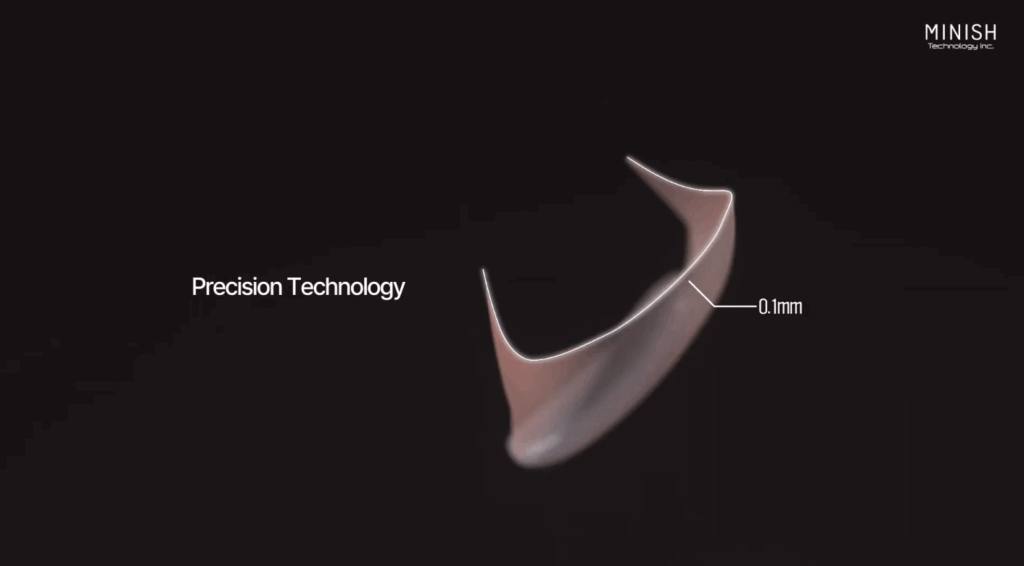
The decision to get veneers is often driven by a desire for confidence, but many patients are rightfully terrified of the procedure itself. Traditional porcelain veneers are typically 0.5mm to 1.5mm thick. Because they are bulky, a dentist must drill away an equivalent amount of your healthy tooth to prevent the final result from looking “thick” or “horse-like.” This process is irreversible and often leads to the “shark tooth” appearance that haunts social media.
Confidence should never come at the cost of your natural teeth.
The Problem With Traditional Veneers
Traditional porcelain veneers are 0.5–1.5mm thick
To make them look natural, dentists must remove an equal amount of healthy enamel
This process is irreversible and can weaken the tooth
Once enamel is removed, it can never be replaced.
The MINISH Solution
MINISH was engineered to solve this exact problem. Our restorations are ten times thinner than traditional porcelain, yet significantly more durable.
Traditional Veneers
Bonding Zone Matters
Traditional veneers often bond to dentin—the softer layer beneath enamel. Because dentin is porous and unstable, veneers are more likely to loosen or leak over time.
MINISH Veneers
Enamel-to-Enamel Bonding
By bonding to enamel, MINISH achieves unmatched strength and durability.
This enamel-to-enamel fusion creates a molecular bond that is nearly impossible to break.
Why Natural Light Matters
Furthermore, traditional veneers can look “flat” or “opaque” because the porcelain is too thick to allow light to pass through. MINISH inherits the natural translucency of your underlying tooth. The light dances through the restoration just like it does with a real tooth, ensuring that your smile looks brilliant in every lighting condition—from the bright sun to a candlelit dinner. By choosing MINISH over traditional veneers, you are choosing a future free from sensitivity, a future where your natural teeth remain strong, and a result that is indistinguishable from the smile you were born with.