
Feldspathic Porcelain Veneers vs Emax Veneers: Pros and Cons
In contemporary aesthetic dentistry, veneers have become a cornerstone for achieving both functional and esthetic excellence. Yet, as clinicians know, the success of veneer treatment depends as much on material selection as on clinical technique. Among the most widely used options are feldspathic porcelain veneers vs Emax veneers, each offering distinct advantages and limitations.
This article reviews the key differences between these two materials, with a focus on their esthetic potential, mechanical performance, and clinical indications, to support informed material selection in daily practice.
Feldspathic Porcelain Veneers vs Emax Veneers – Understanding the Basics
Porcelain and Ceramic in Dentistry
A common point of confusion for those new to the field we would like to address is the precise relationship between the terms “porcelain” and “ceramic”. It is essential to clarify that “porcelain” is not a separate material class but a specific type of ceramic. Historically, dental porcelain was a reference to a material primarily composed of feldspar, quartz, and kaolin, processed through traditional layering and firing techniques.
In modern CAD/CAM dentistry, “porcelain block” often refers to a feldspathic block. These blocks are industrially manufactured from fine-structured feldspathic ceramic, making them a specific type of glass-matrix ceramic used in prosthetics. This distinction provides crucial clarity, as it correctly situates traditional porcelain within the modern framework of dental materials and their classification.
Feldspathic Porcelain Veneers
Dentists widely regard feldspathic ceramics as the gold standard for esthetics, prized for their translucency and enamel-like light diffusion. This makes them especially suitable for anterior restorations where a lifelike appearance is the highest priority. With a flexural strength of only ~60–70 MPa, feldspathic material has both advantages and limitations. On the positive side, it mimics enamel in wear characteristics, bonds well chemically, and produces exceptionally natural results. On the downside, its brittleness can make handling more challenging, especially for less experienced clinicians.
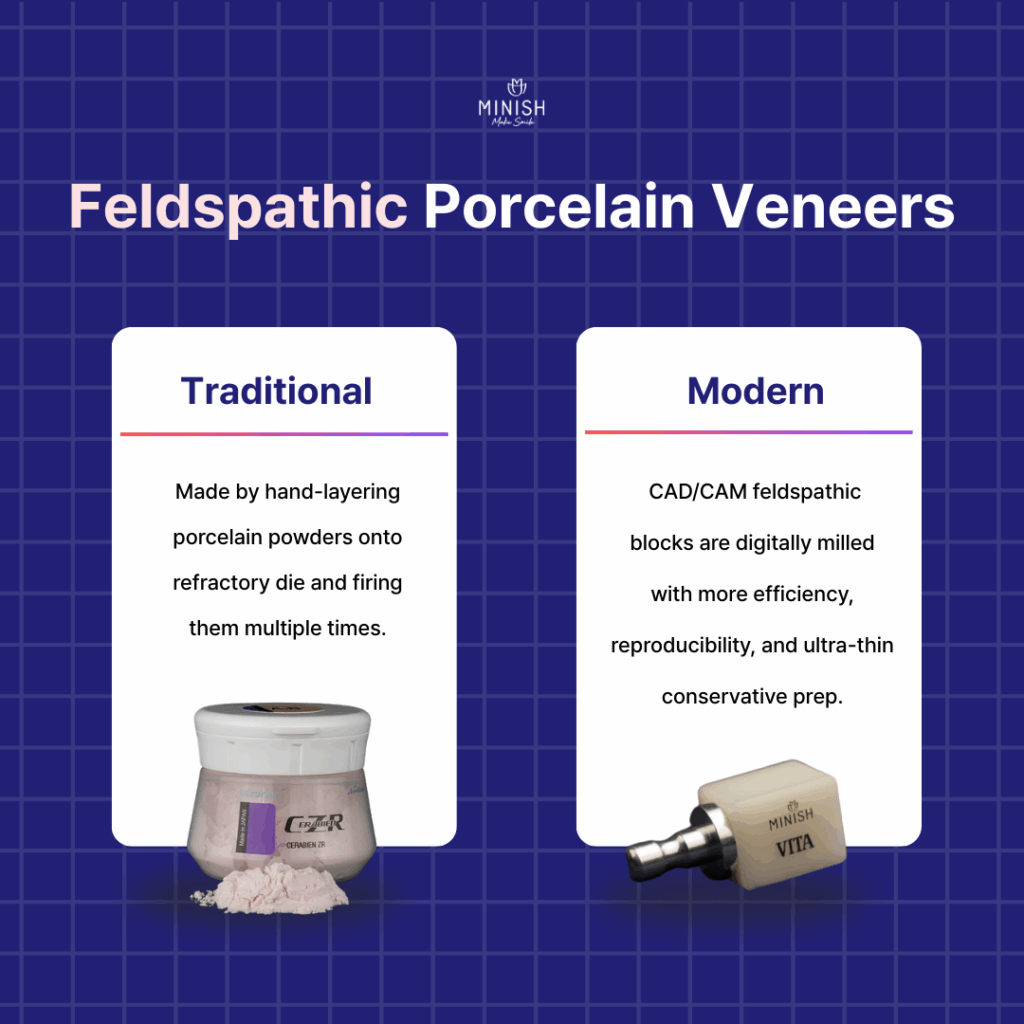
Clinically, feldspathic veneers exist in two distinct forms. Traditionally, technicians fabricated them by hand-layering porcelain powders onto a refractory die and firing the restoration multiple times. This classic approach produces beautiful, highly individualized gradation but often requires greater tooth reduction and exceptional technical skill. By contrast, modern CAD/CAM feldspathic blocks provide the same esthetic qualities with more efficiency, reproducibility, and ultra-thin conservative preps. When further hand-finished, as with MINISH BLOCS, they combine the efficiency of digital milling with the finesse of traditional artistry.
Emax Veneers
Emax produces veneers from lithium disilicate, a high-strength glass ceramic. Lithium disilicate is a type of glass-ceramic that has revolutionized aesthetic dentistry by striking an optimal balance between strength and translucency. Dentists recognize it by the brand name IPS e.max, and chemically, it is lithium disilicate (Li₂Si₂O₅).
The material’s exceptional properties are a result of its unique microstructure, which consists of approximately 70% needle-like lithium disilicate crystals embedded within a glassy matrix. This high concentration of crystals provides significant reinforcement to the glass phase, dramatically increasing the material’s mechanical resilience.
Emax offers a flexural strength of about 360 MPa, allowing it to handle high functional loads. Dentists commonly use it for anterior and posterior restorations, especially in teeth with enamel wear, discoloration, or structural damage.
However, because of its denser structure, Emax usually requires more tooth reduction (approximately 0.3–0.7 mm), which may not be ideal for patients seeking ultra-conservative treatment. Its esthetics are good, though some clinicians consider them slightly less lifelike than feldspathic porcelain under certain lighting or at close range.
Feldspathic vs Emax Veneers – Fabrications and Applications
Dentists fabricate feldspathic porcelain veneers in two distinct ways, each carrying different clinical implications.
Historically, feldspathic veneers were created using a powder–liquid build-up technique. Porcelain powders were incrementally hand-layered onto a refractory die and subjected to multiple firing cycles in a porcelain furnace, allowing each layer to sinter and fuse. This labor-intensive process enables highly individualized characterization, translucency, and shade control, closely replicating natural enamel. However, the technique requires exceptional technical skill and remains time-consuming, with limited mechanical strength (flexural strength ~60–70 MPa). Also, because the layers need space, this technique often requires more tooth reduction compared to CAD/CAM methods.
Traditional hand-layered feldspathic porcelain offers the highest level of translucency among all ceramic veneer materials, closely replicating the natural enamel’s light transmission and depth. Because it contains a high glass content and minimal crystalline structure, it allows light to pass through in a way that mimics the natural enamel-dentin interplay. This makes it ideal for anterior veneers, especially in cases where lifelike esthetics and subtle light diffusion are required.
Modern feldspathic veneers can also be milled from industrially pre-sintered feldspathic ceramic blocks. These blocks provide the same superior translucency and enamel-like light diffusion but allow for a more standardized and efficient CAD/CAM workflow. While they lack the fully customized layering and natural gradation possible with traditional hand-layering and firing, they allow for ultra-thin veneers with more conservative prep and greater reproducibility, especially when hand-refined, as with MINISH BLOCS.
CAD/CAM feldspathic blocks retain much of the translucency of traditional feldspathic porcelain but with slightly less optical nuance due to their monolithic structure. These pre-shaded blocks are still highly translucent compared to other CAD/CAM materials, offering a natural enamel-like brightness, especially in bleach shades, without looking flat or overly opaque. While they lack layered effects, their translucency is sufficient for most anterior cases with good underlying tooth structure.
Emax Veneers Fabrications and Applications
Lithium disilicate blocks are processed using either hot pressing techniques or modern CAD/CAM milling procedures. An important feature of the CAD/CAM workflow is that the blocks are milled in an “intermediate” crystalline phase. In this state, the material contains lithium metasilicate crystals, which are responsible for its machinability and good edge stability. These blocks have a distinctive blue color after milling.
The final strength and aesthetic tooth color are achieved during a post-milling crystallization firing process, which transforms the lithium metasilicate into the final, high-strength lithium disilicate crystals. This two-stage process is an elegant engineering solution that allows for efficient digital fabrication while ensuring a robust final restoration. Due to its balanced properties, lithium disilicate is a highly versatile material used for a broad spectrum of restorations, including single crowns, veneers, inlays, onlays, and three-unit bridges (up to the second premolar).
Emax (lithium disilicate) veneers offer moderate translucency, with options like HT (High Translucency) designed to mimic enamel. However, due to their higher crystalline content, Emax blocks are inherently less translucent than feldspathic porcelain. While suitable for cases requiring both strength and esthetics, Emax can sometimes appear denser or slightly more opaque, particularly in thicker restorations. Its higher strength and ease of handling make it a preferred choice for many clinicians, though it remains less ideal when maximum light transmission and enamel-like optical behavior are the priority.
Feldspathic Porcelain Veneers vs Emax Veneers Cost Comparison
When it comes to veneer cost, feldspathic porcelain veneers and Emax veneers fall into different ranges because of their fabrication methods and clinical applications—not simply because one material is “better” than the other.
- Feldspathic Porcelain Veneers Cost
Hand-layered feldspathic veneers are typically more expensive, reflecting the artistry and time needed to customize translucency, shade, and surface texture. Patients seeking the most natural esthetics and ultra-thin, minimal-prep veneers often consider this investment worthwhile. - Emax Veneers Cost
Emax veneers, made from lithium disilicate, are generally more cost-efficient to produce due to CAD/CAM milling or pressing workflows. This streamlined process reduces lab time, making Emax veneer prices more accessible while still providing strength and good esthetic outcomes. Their long-term durability can also improve overall cost-effectiveness compared to more fragile options.
In summary, the cost difference between feldspathic vs Emax veneers reflects both fabrication technique and clinical suitability. Patients prioritizing lifelike esthetics and minimal tooth reduction may find feldspathic veneers worth the higher price, while those requiring durability and broader functional coverage may benefit from the relative efficiency of Emax veneers.
Choosing the Best Veneer Material for Your Patients
The right type of material depends on treatment goals, and clinical conditions:
| Feature | Feldspathic Ceramic | Lithium Disilicate | Zirconia (for comparison) |
| Classification | Glass-MatrixCeramic | Glass-MatrixCeramic | PolycrystallineCeramic |
| Flexural Strength | ~60-70 MPa | ~360-400 MPa | ~900-1200 MPa |
| Translucency | Excellent | Excellent | Good/Variable |
| Primary Applications | Veneers, Anterior Crowns, Bridges | Crowns, Veneers, Inlays, Bridges | Posterior crowns, long-span bridges, implants |
| Key Advantages | Unmatched aesthetics,Antagonist-friendly abrasion | Optimal balance of strength and aesthetics, versatile | Extreme strength and durability, biocompatible |
| Key Limitations | Low strength, fracture-prone in high-load areas | Not as strong as zirconia forhigh-stress areas | Traditionally opaque, potential for opposing tooth wear |
Conclusion
In summary: No single material is universally “best.” Feldspathic Ceramic excel in ultra-conservative, esthetic-driven cases where highly customized translucency and minimal reduction are priorities. By contrast, lithium disilicate offers greater strength, making it a practical choice for many cosmetic clinicians who want predictable results with fewer handling issues during application and fewer complications in practice.
MINISH BLOCS used for MINISH Veneers is feldspathic ceramic blocks milled and hand-crafted by experienced technicians to create as thin as 0.1mm, having full benefit of aesthetic of feldspathic material, plus digital
Recently, some clinical approaches—such as MINISH BLOCS, which utilizes feldspathic materials and hand-crafting techniques, have begun addressing traditional limitations of feldspathic veneers by combining biomimetic approach, minimally invasive prep, and CAD/CAM precision, bonding techniques, allowing their use even in posterior teeth, bridges, and full-mouth cases.
Frequently Asked Questions (FAQ)
Emax veneers are made from lithium disilicate and are valued for their strength and durability, while feldspathic veneers are hand-layered and prized for superior translucency and lifelike esthetics. With proper case selection and care, both can offer long-lasting results.
Emax veneers typically demonstrate greater longevity due to their high flexural strength and durability, particularly in areas subject to functional stress. Feldspathic veneers can also last long with proper case selection and care.
Feldspathic veneers are best for patients with good enamel and low bite stress, especially when a highly natural appearance is the goal. They are most often used for anterior esthetic enhancements.
Feldspathic veneers are easier to polish or modify chairside. Emax veneers are more challenging to modify after bonding due to their dense ceramic structure.
Feldspathic veneers usually come with higher lab fees because they require detailed hand-layering and highly skilled technicians.
Upcoming Event
MINISH Veneers U.S. Course in California
Friday-Sunday, May 22-24th, 2026 | VITA North America, Brea, California
Reserve Your Spot Today!
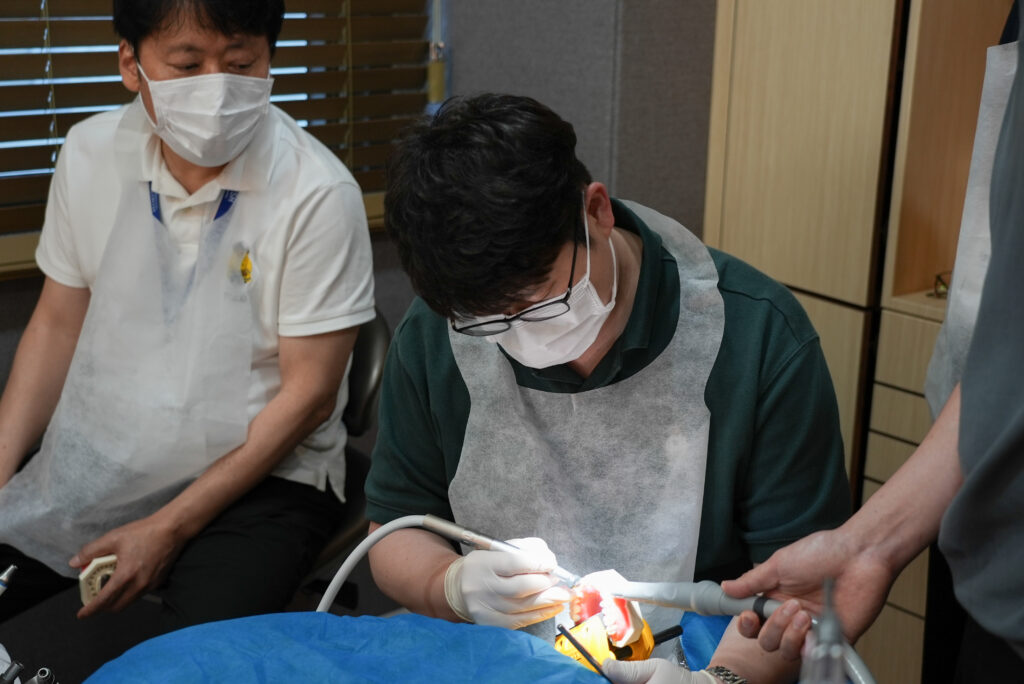
Ready to elevate your practice with minimally invasive excellence? Reserve your spot in the next MINISH Veneer course and be part of the future of restorative dentistry.
Check Out Our Other Blog Posts!
Looking for more insights on cutting-edge dental technology, minimally invasive treatments, and tips for preserving natural tooth structure? Explore our latest blog posts—from expert advice by Dr. Kang to real success stories and insights from MINISH Dental Hospital.
Whether you’re a dental professional or a curious patient, you’ll find valuable info on everything from tooth integrity, oral health, and innovative dental solutions to the science behind MINISH Veneers.
👉 Stay informed. Stay inspired.